The Evolution of Women's Fashion Through the Decades: A Century of Style
How Fashion Reflects the Women of Each Era
Women's fashion has never been just about clothes. Every hemline, silhouette, and fabric choice carries the fingerprints of its time — the politics, the anxieties, the freedoms, and the ambitions of the women who wore them.
Think about it this way: a garment is a kind of argument. The 1920s flapper dress argued for physical freedom. The 1980s power suit argued for professional equality. Today's sustainable fashion movement argues for planetary responsibility. The clothes change, but the conversation underneath them never really stops.
Understanding how women's fashion evolved across the decades isn't just an exercise in nostalgia. It gives modern shoppers a richer framework for making style choices — one that goes far beyond "what's trending this season."
The 1920s–1940s — Liberation, Glamour, and Wartime Pragmatism
The 1920s marked one of the most dramatic silhouette shifts in fashion history, as the rigid corset era gave way to the loose, drop-waisted flapper style. Women's fashion didn't just change — it rebelled.
Flappers wore shorter hemlines (scandalously above the knee), cropped hair, and straight, unstructured silhouettes that rejected the hourglass ideal of the Victorian and Edwardian eras. This wasn't merely aesthetic preference. It coincided directly with women gaining voting rights in the United States in 1920 and a broader cultural push for independence. The body itself became a site of liberation.
The 1930s shifted the mood. Hollywood's golden age brought glamour back — bias-cut silk gowns that clung to the body, elegant accessories like long gloves and structured handbags, and a more overtly feminine silhouette. Women like Katharine Hepburn and Marlene Dietrich turned the silver screen into a fashion runway that millions of ordinary women studied and emulated.
Then came the 1940s, and with them, World War II. Fabric rationing fundamentally reshaped women's clothing — not by choice, but by necessity. Skirts shortened and narrowed, shoulder pads appeared (partly influenced by military styling), and utility became the defining principle. Women working in factories wore trousers in significant numbers for the first time. That practical shift would have lasting consequences for how women thought about what they were allowed to wear.
The 1950s–1960s — New Looks, New Freedoms
The post-war era brought a deliberate return to femininity — most famously through Christian Dior's 1947 "New Look," which the fashion press celebrated and some women found suffocating. The post-war New Look silhouette — nipped waist, full skirt, rounded shoulders — was a deliberate contrast to wartime austerity, but it also pushed women back toward a domestic ideal at a moment when many had tasted professional independence.
The tension between that idealized femininity and women's growing restlessness defined the decade. By the late 1950s, a younger generation was already pushing back.
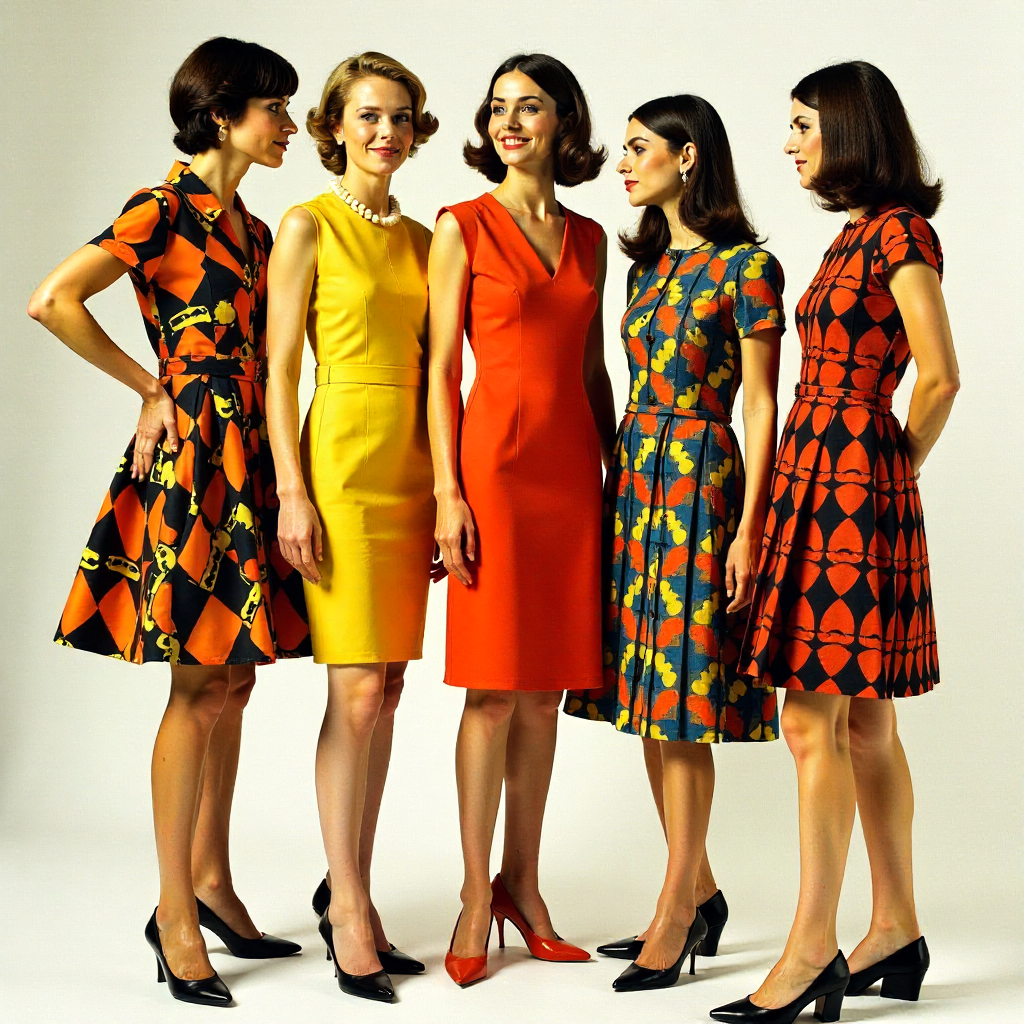
The 1960s exploded that tension wide open. The A-line shift dress, the miniskirt, geometric prints, and mod fashion — all of it reflected a youth culture that had no patience for its mothers' white gloves and structured suits. The women's liberation movement was gaining momentum, and fashion responded: trousers became mainstream for women, bras were symbolically rejected, and the idea that women's clothing should prioritize male approval over female comfort was openly challenged.
Accessories tracked the shift too. The structured handbag of the 1950s gave way to the simple shoulder bag. Kitten heels became block heels, then flat boots. Each change was small on its own, but together they told a story of women redefining what dressing up actually meant.
The 1970s–1980s — Self-Expression and Power
The 1970s offered women something genuinely new: the freedom to dress in multiple directions at once. Bohemian maxi dresses, flared trousers, peasant blouses, and earthy prints coexisted with disco-era glamour — sequins, halter tops, platform heels. The decade had no single dominant silhouette, which was itself a kind of statement.
The women's liberation movement had done its work culturally, and fashion reflected a new confidence in self-expression over conformity. Women were dressing for themselves, not for a singular prescribed ideal.
Then came the 1980s, and the corporate world became the new battleground. Power dressing — broad shoulder pads, structured blazers, strong silhouettes — emerged as women entered executive roles in larger numbers and needed a visual language that commanded authority in boardrooms designed for men. The shoulder pad wasn't just a fashion choice; it was armor.
It's worth being honest about the trade-off here: power dressing borrowed heavily from masculine tailoring, which raises a real question about whether women were gaining access to power on their own terms or adapting to spaces that hadn't changed to accommodate them. Fashion historians still debate this. What's undeniable is that the 1980s corporate woman created one of the most recognizable silhouettes of the 20th century — and one that designers keep revisiting.
The 1990s–2000s — Minimalism Meets Maximalism
The 1990s arrived as a deliberate exhale after the excess of the 1980s. Minimalism became the defining aesthetic: clean lines, neutral palettes, slip dresses, Calvin Klein basics, and the "less is more" philosophy that Helmut Lang and Jil Sander turned into high fashion. The shift dress came back, stripped of ornament.
Grunge offered a parallel counter-narrative — flannel shirts, combat boots, deliberately unkempt styling — but both movements shared an anti-excess sensibility. Women were rejecting the idea that more effort, more volume, more decoration automatically meant more style.
The early 2000s reversed course hard. Logo-heavy handbags, low-rise jeans, velour tracksuits, and maximalist accessories defined an era that fashion historians now treat with a mixture of affection and horror. Fast fashion was accelerating rapidly during this period, making trend cycles shorter and clothing cheaper — but also more disposable. The average garment was worn significantly fewer times before being discarded compared to previous decades.
The 2000s also marked the beginning of celebrity culture's total dominance over fashion. What a pop star wore on a Tuesday could sell out by Thursday. The relationship between women's clothing and media influence had never been more direct — or more commercially driven.
The 2010s to Today — Inclusivity, Sustainability, and Nostalgia
Contemporary women's fashion is defined by three forces pulling in different directions: a genuine push toward inclusivity and body-positive fashion, a growing sustainable fashion movement reacting against fast fashion's damage, and an almost constant recycling of past decades as aesthetic inspiration.
The body-positive movement reshaped how brands design, photograph, and market women's clothing in ways that would have been unimaginable in 1995. Extended sizing, diverse runway casting, and the rejection of a single "ideal" silhouette represent real structural changes — even if progress remains uneven across the industry.
Sustainable fashion has moved from niche to mainstream concern. Brands like Patagonia and Eileen Fisher built entire identities around it, while fast fashion giants face increasing scrutiny for environmental and labor practices. The UN's sustainable fashion initiative has pushed the conversation into policy discussions, not just consumer choices. Choosing slow fashion — buying fewer, better-made pieces — is increasingly framed as both an ethical and a stylistic statement.
The nostalgia cycle has also accelerated. Y2K aesthetics dominated the early 2020s. 1970s boho prints resurface every few years. 1990s minimalism never fully left. Understanding fashion history gives modern women a real advantage: they can spot a revival, assess whether it suits them, and style it with intention rather than just following a trend.
What Timeless Style Lessons Can We Take From Fashion History?
Fashion history offers practical guidance for building a wardrobe that lasts beyond a single season. The most useful lessons aren't about copying a specific decade — they're about understanding why certain choices endure.
- Silhouette is the foundation. Every era's most iconic looks are defined first by shape, not color or print. Before buying any piece, consider whether the silhouette actually works for your body and lifestyle.
- Context matters for accessories. Hemlines, handbags, and heels have always functioned as signals — of status, attitude, and era. Wearing vintage-inspired accessories thoughtfully means understanding what they originally communicated.
- Trends are cyclical, but personal style isn't. The 1990s minimalism revival proves that clean, well-made basics outlast almost every trend. Investing in quality over quantity is advice that every decade's fashion history validates.
- Clothes carry meaning. The women who wore flapper dresses, power suits, or grunge flannels were making statements. Dressing with awareness of that history adds depth to personal style choices.
- Ready-to-wear fashion democratized style — but it also created the conditions for fast fashion's problems. Supporting sustainable fashion brands and buying secondhand are ways to engage with that history honestly.
The through-line across a century of women's fashion is this: what women wear has always reflected what women want, fear, fight for, and celebrate. That's what makes fashion history genuinely worth knowing.
Frequently Asked Questions
What decade had the most iconic women's fashion?
The 1960s is widely considered the most transformative decade for women's fashion. The introduction of the miniskirt, mod aesthetics, and the influence of the women's liberation movement created silhouettes and attitudes that designers still reference today.
How did women's fashion change after World War II?
After WWII, fashion shifted dramatically toward a hyper-feminine silhouette — most famously through Dior's New Look in 1947, featuring a nipped waist, full skirt, and soft shoulders. This was a deliberate contrast to wartime utility clothing, though it also represented a cultural push to return women to domestic roles.
What is power dressing and when did it start?
Power dressing refers to the structured, shoulder-padded style that emerged in the early 1980s as women entered corporate environments in larger numbers. It borrowed visual authority from menswear — broad shoulders, tailored blazers, strong silhouettes — to project confidence and professionalism.
How does sustainable fashion connect to fashion history?
Sustainable fashion is a direct response to the fast fashion model that accelerated in the 1990s and 2000s. Historically, clothing was made to last and repaired when worn — the "slow fashion" approach now advocated by sustainability movements is actually a return to pre-industrial clothing practices.
Which vintage fashion trends are popular again today?
Currently, Y2K aesthetics (low-rise jeans, logo accessories), 1990s minimalism (slip dresses, neutral basics), and 1970s bohemian prints are all experiencing strong revivals. Understanding the original cultural context of these trends helps in styling them in a way that feels intentional rather than purely imitative.